

Table of Contents
- What Separates Pro-Grade Fly Fishing Gear From Entry-Level Kit
- Rods and Reels Worth the Money for Seasoned Anglers
- Fly Lines, Backing, and Tippet: The System Most Anglers Get Wrong
- What to Spend On vs Skimp On in Fly Fishing
- Fisherman's Netting, Hemostats, and the Accessories That Earn Their Place
- Fly Fishing Gear Maintenance Tips for Gear That Lasts Decades
- Specialized Setups: Saltwater, Travel, and Modern Tech Integration
- Conclusion: Build a Kit That Matches Your Water
- Frequently Asked Questions
Last Updated: October 9, 2026
What Separates Pro-Grade Fly Fishing Gear From Entry-Level Kit
The gap between entry-level and pro-grade fly fishing gear comes down to three things: material consistency, component tolerances, and how the gear behaves after a decade. At The Reeling Church Co., we have handled enough vintage and gently used tackle to know a $400 rod and a $900 rod often cast similarly on day one. The difference shows up in year five.
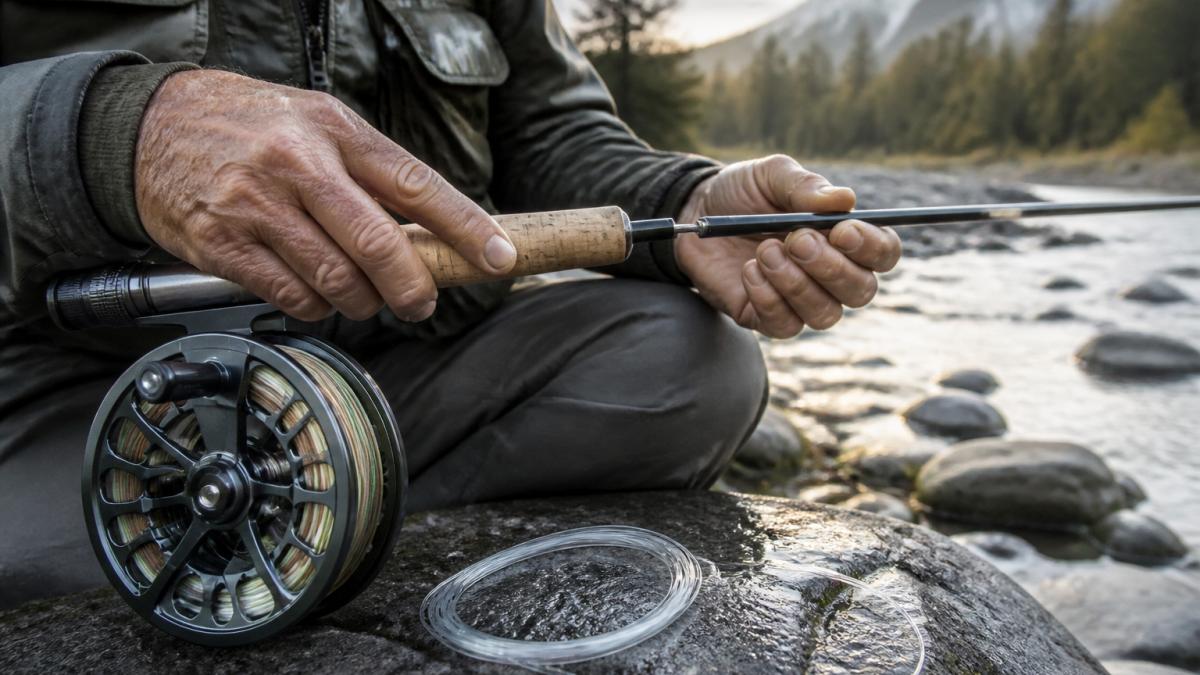
Rod action, ferrule design, and reel seat quality determine whether a rod still feels crisp after years of fishing. Entry-level blanks soften unevenly; pro-grade blanks hold their recovery because resin content and wall thickness are controlled more tightly.
Rod Action, Ferrule Design, and Reel Seat Quality
A fly rod's action describes how the blank flexes under load. Fast action rods bend mostly in the upper third, suiting long casts and wind; medium action bends deeper into the middle, favoring delicate presentations and shorter distances.
Ferrule design matters more than most buyers realize. Poorly machined ferrules develop a clicking sensation that kills accuracy; well-fitted ferrules seat firmly with a quarter turn and stay tight.
The reel seat is the third tell. Look for double-locking nuts and a machined aluminum body rather than plastic or graphite. A loose reel seat wobbles under drag pressure, transferring straight into your line.
Drag Systems, Arbor Size, and Line Memory
A drag system applies smooth, adjustable resistance when a fish runs.
Arbor size affects retrieval speed and line memory. A large arbor reel picks up line faster and coils it in wider loops, reducing the tight memory that causes tangles, the most common cause of frustrating casting loops.
Rods and Reels Worth the Money for Seasoned Anglers
For experienced anglers, the smartest money goes into a rod with proven taper design and a reel with a genuine drag system, not the newest graphics package. Our top pick for most trout and streamer work is the TFO Lefty Kreh Pro Series 10' #5 at $219.00, used, in excellent condition, with no cracks, no repairs, and intact guides.
The 10-foot length gives you reach for mending and high-sticking, and the 5-weight rating covers everything from size 18 dries to weighted streamers. It ships as a 4-piece, which matters if you travel.
TFO Lefty Kreh Pro Series 10' #5: Best for Nymphing and Streamers
Temple Fork Outfitters built their reputation on rods that perform above their price point, and the Lefty Kreh Pro Series is the clearest example. This blank was developed with Lefty Kreh for long-range presentation and big-water versatility.
What it does well: Euro nymphing, indicator fishing, and streamer work. The 10-foot length keeps line off the water when tight-lining nymphs, and the 5-weight has enough backbone to turn over a weighted streamer.
Where it falls short: it is a used rod sold as-is. If you want a factory warranty and a plastic wrapper, this is not that. If you want a proven taper at a pre-owned price, it is hard to beat.
G-Loomis Venture 3 and Leo Professional Reels: Large Arbor, Real Drag
The G-Loomis Venture 3 at $249.99 is a large-arbor reel for 3-weight lines, weighing 7.6 ounces. This gently used example is mint with the original box and a 3-weight sink line included. The large-arbor design speeds retrieval and cuts line memory, and the adjustable drag is smooth through its range.
For a lighter price point, the Leo Professional Fly Reel at $29.99 is CNC-machined aluminum with a ventilated spool, available in sealed bearing or click spring configurations and in 3/4, 5/6, and 7/8 weights. The click-and-pawl version suits dry fly fishing where touch matters; the sealed bearing version handles grit and repeated use better.
| Reel | Price | Arbor | Best For | Drag Type |
|---|---|---|---|---|
| G-Loomis Venture 3 | $249.99 | Large | 3wt trout, mountain streams | Adjustable disc |
| Leo Professional | $29.99 | Ventilated | Spring creeks, tailwaters | Sealed bearing or click |
| Raft Reel Professional | $27.99 | Ventilated | Technical casts, hard pulls | Consistent adjustable |
The Raft Reel Professional at $27.99 rounds out the lineup with a precision-machined frame and a ventilated spool that promotes quick line drying.
Fly Lines, Backing, and Tippet: The System Most Anglers Get Wrong
The line system is where experienced anglers quietly lose performance: a great rod with a mismatched line casts worse than a modest rod with a balanced setup.
Weight forward taper, sink rate, and tippet material have to work together. Weight forward lines put the mass at the front, loading the rod fast and turning over bulky flies. Our Premium Floating Fly Lines at $29.00 use a weight forward taper on a European braided multi-filament core, in 3F through 8F and four colors.

Weight Forward Taper, Sink Rate, and Fluorocarbon Tippet Selection
Sink rate determines how deep and fast your fly gets down. A weight forward sinking line delivers depth and distance for lakes, deep runs, and still water. Our Premium Sinking Fly Lines run 27.5 m (90 ft) with a uniform sink rate in WF-3S through WF-9S.

Backing is the quiet foundation. Braided backing loads the reel efficiently and holds integrity season after season. Our Braided Fly Line Backing at $9.00 comes in 50 M and 100 M lengths with 20 lb and 30 lb test options.

What to Spend On vs Skimp On in Fly Fishing
Spend on the rod, the line, and the reel drag. Skimp on things that wear out, get lost, or do not affect casting performance.
Here is how we would allocate a realistic budget:
- Rod: 40-50% of total budget. The blank is the one component you cannot upgrade later.
- Reel: 20-25%. Prioritize a smooth drag over cosmetics.
- Fly line: 10-15%. A mismatched line ruins a good rod.
- Backing and tippet: 5%. Inexpensive and replaceable.
- Accessories: 10-15%. Buy quality where you touch it daily.
The gear that earns a premium price changes how the cast behaves or how the fish fights. Everything else is preference.
Fisherman's Netting, Hemostats, and the Accessories That Earn Their Place
Fisherman's netting, hemostats, and nippers are accessories that can change your day on the water.
Nippers cut tippet cleanly so knots seat properly.
Our Fishing Clippers at $9.25 use stainless steel blades and come in hand-painted Brown Trout, Rainbow Trout, and Brook Trout patterns. For dry fly storage, the Leather Fly Roll at $30.95 uses a sheepskin interior that wicks moisture away from hackles, and a Neoprene Fly Reel Cover at $9.99 protects a reel in transit.
U.S. Fish and Wildlife Service guidance on catch and release fishing
Fly Fishing Gear Maintenance Tips for Gear That Lasts Decades
Fly fishing gear maintenance tips matter most for rods, reels, and lines, since those three carry the highest replacement cost. A few habits each season add years to all of them.
Start with the rod. After every trip, wipe the ferrules with a clean cloth and check for grit, grit acts like sandpaper and wears the joint loose. Store rods in the sock and tube, never leaning in a hot car.
For reels, rinse with fresh water after salt or silt exposure, then dry before storing. Do not submerge a sealed drag reel, and do not spray lubricant into a click-and-pawl mechanism, because oil attracts grit.
Fly lines need the most attention and get the least. Clean lines cast farther and float higher. Wipe them with a mild soap solution a few times a season.
-
Check guides for nicks with a cotton swab; snags mean a line-shredding burr
-
Inspect backing for fraying at the arbor knot
-
Store flies in a dry roll or box to prevent rust
American Museum of Fly Fishing on caring for historic tackle
Specialized Setups: Saltwater, Travel, and Modern Tech Integration
Specialized setups separate a generalist kit from one built for a specific fishery. Saltwater, travel, and technology-driven setups each demand different choices.
For saltwater, prioritize a sealed drag, corrosion-resistant hardware, and a heavier line weight. A 7/8 weight reel with a fully enclosed bearing handles sand and spray far better than an open click-and-pawl, which is why our Leo Professional comes in 7/8 weight with a sealed bearing option.
Travel configurations favor four-piece rods and compact reels. A 4-piece rod fits in a carry-on tube, and a lighter large-arbor reel keeps the kit portable. If you fly to fish, pack two lines rather than two rods.
NOAA tide and current predictions for coastal anglers
Conclusion: Build a Kit That Matches Your Water
The hardest part of buying gear as an experienced angler is resisting the urge to buy everything at once. Build around the water you actually fish, upgrade the line system first, and let the rod and reel follow.
At The Reeling Church Co., we curate vintage, new, and gently used gear for anglers who care about authenticity, and select items support the Second Season Foundation's work with lung transplant recipients through outdoor activity. Our collection includes proven rods and reels, handcrafted fly storage, and the small tools that make a day on the water work.
Shop our fishing gear and build a kit that matches your water, your species, and your experience level.
Frequently Asked Questions
What distinguishes professional-grade fly fishing gear from entry-level equipment?
The differences show up in components you touch every cast. Pro-grade rods use tighter ferrule tolerances and better cork, so the blank loads without flat spots. Reels move to large arbor designs with sealed or adjustable drag systems instead of simple click paws. Lines use weight forward tapers and low-memory coatings that shoot cleanly. Entry-level gear still catches fish, but it wears faster and gives up accuracy in wind or at distance.
Why is high-quality fly line critical for experienced anglers?
The line carries the cast, not the rod. A weight forward taper loads fast and turns over heavy streamers or dry flies with equal control, which matters more as your presentation gets technical. Line memory and coating quality also decide how the line tracks through guides after a cold morning. Premium Floating Fly Lines and Premium Sinking Fly Lines both run $29.00 and cover 3F through 8F, so matching line weight to your rod is straightforward.
How do I maintain high-end fly fishing gear so it lasts decades?
Rinse reels and rods with fresh water after every saltwater or silty trip, then dry them fully before storage. Strip line off the reel, clean it with a mild soap solution, and let it dry out of direct sun to slow coating breakdown. Store rods in their socks and tubes with ferrules clean, and check guides for nicks that fray line. A $9.99 Neoprene Fly Reel Cover prevents most transit damage.
What gear should I invest in for long-term durability?
Spend on the rod, the reel drag, and the fly line, because those three decide how the whole system performs. Backing and tippet are cheap to replace and rarely fail when fresh. A used TFO Lefty Kreh Pro Series 10' #5 at $219.00 or a G-Loomis Venture 3 at $249.99 gives you pro-level performance at pre-owned prices, and both hold value if you maintain them. Skimp on clippers instead.
How does specialized gear improve success on difficult waters?
Difficult water usually means depth, distance, or drag. A sinking line with a uniform sink rate puts a streamer in the strike zone on still water and deep runs. A 10-foot rod gives you line control for Euro nymphing and indicator rigs when fish hold tight to structure. Each piece solves one specific problem, which is why experienced anglers carry more than one setup.