

Table of Contents
- Types of Fisherman's Netting: Natural vs Synthetic Materials
- Decorative vs Functional Netting: Choosing the Right Style
- The Fly Fishing Landing Net: Rubber vs Nylon Fishing Nets
- Technical Mesh Sizing Guide for Fisherman's Netting
- How to Clean a Fishing Net and Maintain Its Durability
- Installation and Mounting Tips for Netting
- Environmental Impact and Sustainability in Netting
- Conclusion
- Frequently Asked Questions
Last Updated: September 30, 2026
Types of Fisherman's Netting: Natural vs Synthetic Materials
Fisherman's netting is the mesh material used to build landing nets, decorative displays, and pond covers, and it falls into two families: natural and synthetic fibers. The choice shapes how the net feels in your hand and how long it survives sun, salt, and hard use.
Natural netting means cotton, linen, and hemp, often hand-woven. It looks warm and ages with character, but absorbs water, dries slowly, and breaks down faster under UV. Synthetic netting means nylon, polyester, and rubber-coated mesh. It resists moisture, rot, and holds its shape for years, with a cooler, more industrial look.
For a landing net that sees real water time, synthetic wins on durability.
Decorative vs Functional Netting: Choosing the Right Style
Functional netting must hold weight, resist abrasion, and handle fish without damage. Decorative netting is built to be seen.
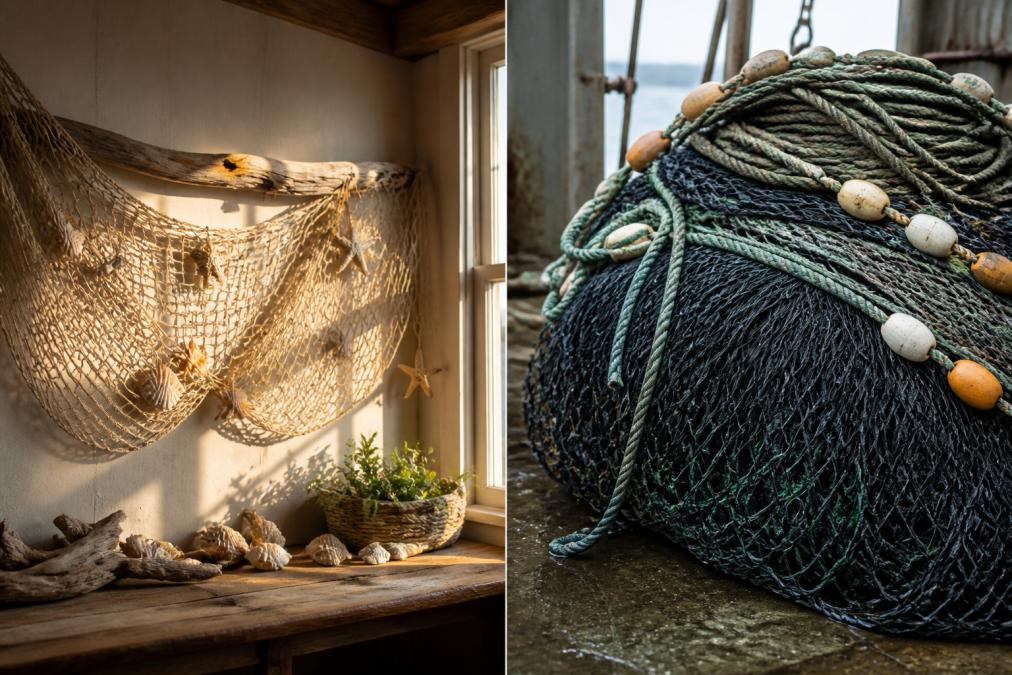
| Type | Best For | Material | Durability |
|---|---|---|---|
| Functional | Landing nets, pond covers | Heavy-duty nylon, rubber | High, weather-resistant |
| Decorative | Wall decor, party styling | Cotton, light jute | Low to moderate, indoor only |
| Hybrid | Coastal theme displays, lodges | Coated hemp, cotton blend | Moderate, sheltered use |
The Fly Fishing Landing Net: Rubber vs Nylon Fishing Nets
The fly fishing landing net debate comes down to fish safety. Rubber and rubber-coated netting protect the fish's slime layer, which matters enormously for catch and release. Traditional nylon is lighter and cheaper, but strips that coating and tangles hooks and fins.
Technical Mesh Sizing Guide for Fisherman's Netting
Mesh size determines what a net catches, holds, or lets fall through, and it is the specification most buyers overlook. It is the measurement between adjacent knots or the diagonal opening of a mesh cell, dictating both function and appearance.
Use this guide:
- Small fish, catch and release: 6-10mm mesh, protects fins and gills
- General trout and bass: 12-20mm mesh, good drainage and fish safety
- Large game fish: 25-40mm mesh, fast draining, lighter carry
- Pond predator protection: 12-25mm mesh, excludes birds and mammals
- Decorative wall decor: any size, chosen for visual interest
How to Clean a Fishing Net and Maintain Its Durability
Cleaning a fishing net takes ten minutes and adds years to its life, but the real gap in most guides is repair.
The cleaning routine
- Rinse the net and frame in cool fresh water after every trip, especially after saltwater or mud. Salt abrades synthetics and draws moisture into natural fibers.
- Scrub gently with a soft brush and mild soap; avoid bleach or citrus solvents.
- Inspect for cuts, fraying, or loose knots while wet, damage is easier to see when fibers are swollen.
- Dry completely in the shade. UV is the biggest killer of both natural and synthetic netting.
- Store hanging, not folded, to prevent creases that become weak points.
For wooden frames, wipe with a lightly oiled cloth once a season to keep the grain from drying and cracking. For rubber mesh, avoid petroleum-based cleaners, which degrade the coating and turn it tacky.
How to repair torn netting
Small cuts in synthetic mesh (nylon, polyester, rubber-coated):
- Find the two broken ends of the same mesh strand.
- Tie them with an overhand knot, pulled tight against the adjacent mesh cell.
- Trim tails to about 3mm so they don't snag hooks or fins.
- If the cut spans more than one cell, cut matching twine about twice the tear length, weave it through surrounding cells in the original pattern, and knot both ends.
Larger tears or a broken frame-to-mesh binding:
- The binding is where nets fail first. Re-lash the mesh to the frame with a waxed polyester cord using a series of half hitches spaced every 2-3cm.
- Waxed cord grips better than bare twine and resists rot.
Natural fiber netting (cotton, hemp, linen):
TRCCo. Beautiful Wood Burl Fishing Net →
- Repair is possible but rarely invisible; a patch shows and absorbs water differently than surrounding mesh.
- Another reason to reserve natural fiber for indoor decor, where a visible repair reads as character rather than damage.
Rubber mesh:
- Seal small nicks with a drop of flexible rubber cement made for waders. Never use superglue, it cures brittle and cracks the first time the mesh flexes.
When to replace instead of repair
Repair stops making sense when:
- More than about 10% of mesh cells are damaged.
- The frame is cracked, delaminating, or has a soft spot.
- The binding has failed in more than one place.
- Rubber mesh is sticky, chalky, or shedding, the coating is gone and fish safety is compromised.
Installation and Mounting Tips for Netting
Mounting netting properly prevents sagging, tearing, and displays that droop within a month. Installation depends on whether the net carries weight or just hangs, and whether it must stop a heron or just look like it could.
Wall decor: hanging without sag
For a decorative wall display, the goal is even tension with no visible hardware.
- Hardware: Use rustproof hooks (stainless or brass) or a wooden batten along the top edge. A batten distributes load better and hides attachment points.
- Spacing: Space attachment points every 30-45cm, closer on heavier netting, wider on light cotton.
- Tension: Pull slightly taut, but not so tight it distorts the mesh and loses the draped, organic look.
- Anchoring: In drywall, use toggle bolts or anchors rated for at least 2-3x the net's weight. A wet cotton net can weigh several times what it does dry.
- Layering: Attach shells, driftwood, or lights to the wall or batten, not the net. Hanging weight from mesh stretches it out of shape.
Pond covers and predator protection: tension is everything
A pond cover that sags is a pond cover that fails. Herons and raccoons will find the low point.
- Height: Keep the net at least 30-45cm above the water. A heron can stab through a net sitting directly on the surface.
- Stakes: Drive stakes at 1.5-2m intervals, with taller corner stakes to keep the net from pulling inward.
- Tension: The net should dip but not touch the water when a bird lands. Add a center support post or light cable on spans wider than about 4m.
- Clearance: Keep the net clear of plants, pumps, and skimmers, contact points wear through mesh fastest.
- Edge security: Bury or pin the perimeter edge. A net that stops at the ground line gives a raccoon an easy lift point.
Landing nets: check the binding, not just the mesh
For functional landing nets, the frame-to-mesh connection fails first. Check it each season:
- Inspect the binding cord for fraying or UV chalkiness.
- Confirm the mesh is centered in the hoop, off-center mesh loads unevenly and tears at the tight side.
- On wooden frames, check the hoop-to-handle joint for play; a loose joint will crack the frame under load.
Carrying your net on the water
If you carry your net on the water, a proper holder changes the experience. Our Leather Net Holster slides onto a wading belt or waistband and keeps the net secure without snagging brush. The Leather Belt Net Holder does the same job in full-grain leather that ages with use.


Environmental Impact and Sustainability in Netting
Sustainability in netting comes down to material choice and lifespan, and the two are linked. The longer a net lasts, the less material ends up in landfill. A durable synthetic net serving fifteen years often has a lower environmental cost than three natural nets that rot in five.
Conclusion
Choosing fisherman's netting means answering one question first: will this net touch water, weight, or weather? Answer that, and material, mesh size, and mounting method follow naturally. Anglers who get this right buy once and fish for years.
Frequently Asked Questions
What is a fisherman's net called?
A fisherman's net is commonly called a landing net or fishing net. In professional angling, it's often referred to as a keepnet (for holding fish) or a hand net. For fly fishing, the term landing net is standard. These nets typically feature a hoop, handle, and mesh bag made from rubber or nylon. Understanding the terminology helps when shopping for specific gear.
What are the downsides of using fishing nets?
Downsides include potential fish injury if the mesh is too coarse or abrasive, especially with nylon nets that can remove protective slime. Rubber nets reduce this risk. Nets can also tangle in vegetation, and cheap materials degrade quickly under UV light. Proper cleaning and storage extend lifespan. For catch and release, rubber netting is preferred to minimize harm.
How do you properly maintain a fishing net to extend its lifespan?
Rinse your net with fresh water after every use, especially in saltwater. For how to clean a fishing net, use mild soap and a soft brush to remove dirt and fish slime. Hang to dry completely before storing. Avoid prolonged sun exposure. Check for fraying or cracks in the mesh and repair or replace as needed. Leather parts should be conditioned occasionally.
What materials are used in modern versus vintage fisherman's netting?
Modern nets often use rubber or synthetic nylon for durability and fish safety. Vintage nets typically feature natural cotton or linen mesh, hand-woven and often found in decorative pieces. Rubber vs nylon fishing nets differ in fish handling: rubber is gentler, nylon is more abrasive. Vintage nets are prized for rustic aesthetic and coastal theme decor.