

Table of Contents
- Fenwick Eagle Rod: A Legacy Graphite Blank That Still Earns Its Place
- Key Features and Specifications of the Fenwick Eagle Rod
- How to Choose a Fly Rod Weight for the Fenwick Eagle
- Sensitivity, Action, and Performance on the Water
- Line Weight and Lure Weight Optimization for the Eagle Rod
- Fly Fishing Rod Maintenance Tips for Long-Term Performance
- Paired Reel Recommendations and Target Species
- Vintage vs. New Fenwick Eagle Rods: What Changed
- Frequently Asked Questions
Last Updated: September 26, 2026
Fenwick Eagle Rod: A Legacy Graphite Blank That Still Earns Its Place
The Fenwick Eagle rod has been a fixture on North American rivers since the 1970s, and its graphite blank remains one of the most recognizable entry points into serious fly fishing. For anglers who demand quality and authenticity, The Reeling Church Co. offers a curated selection of premium fly fishing gear, including vintage, new, and gently used rods.
Key Features and Specifications of the Fenwick Eagle Rod
The Fenwick Eagle rod is a graphite fly rod built for all-around performance across trout, salmon, and steelhead, with a moderate-fast taper, cork handle, and durable reel seat.
Blank Construction and Taper
Most Eagle models use a graphite blank in the 24-ton to 30-ton range, depending on generation. Lower modulus graphite bends more progressively, making the rod forgiving on short casts and easier to load for anglers still dialing in their timing.
Components: Reel Seat, Guides, and Cork Handle
The components tell you what kind of rod this is: a classic cork handle, a hook keeper above the grip, and a reel seat that has varied between uplocking and downlocking styles across generations. Guides are typically chrome or stainless.
None of this is flashy. All of it works.
How to Choose a Fly Rod Weight for the Fenwick Eagle
Choosing a fly rod weight for the Eagle comes down to matching the rod to the fish and the water, not your ego.
| Target Species | Recommended Weight | Typical Water |
|---|---|---|
| Trout (small streams) | 3-4 weight | Tight, brushy creeks |
| Trout (general rivers) | 5 weight | Open rivers, mixed hatches |
| Bass, larger trout | 6 weight | Lakes, warmwater rivers |
| Steelhead | 7-8 weight | Big rivers, coastal runs |
| Salmon | 8-9 weight | Large rivers, tidal water |
Sensitivity, Action, and Performance on the Water
Sensitivity on the Fenwick Eagle rod sits mid-pack. It's not a high-modulus tournament blank, but it transmits enough feel through the cork handle to detect soft takes and set the hook cleanly.
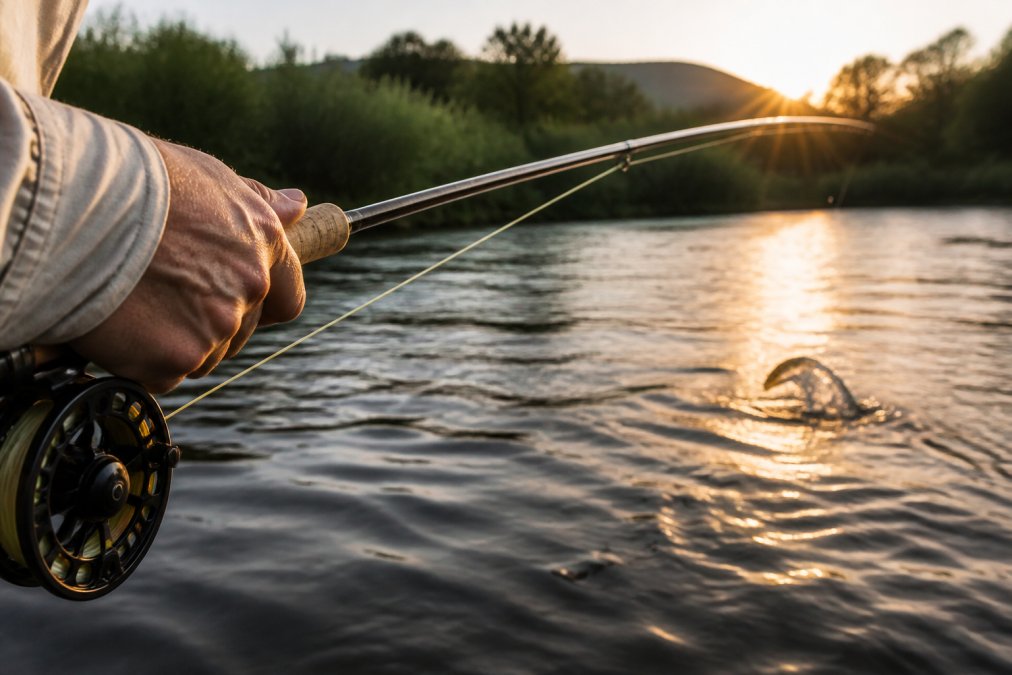
On the water, the Eagle does three things well:
- Rolls out casts in tight quarters where a backcast isn't possible
- Mends line with enough tip sensitivity to stay in the strike zone
- Fights fish with a progressive bend that protects light tippets
Line Weight and Lure Weight Optimization for the Eagle Rod
Most Fenwick Eagle rod reviews stop at the line rating printed on the blank. That's the starting point, not the answer, the real question is where the taper actually loads best, and that sweet spot is narrower than the label suggests.
Finding the Grain Window, Not Just the Line Weight
A 5-weight Eagle is rated for a 5-weight line, but "5-weight" is a range, not a fixed number. Under the AFFTA standard, a 5-weight fly line's first 30 feet weighs between 134 and 146 grains. That 12-grain spread matters on a moderate-fast graphite blank like the Eagle.
Matching Line Taper to the Fishing You Actually Do
| Fishing Style | Line Taper | Why It Works on the Eagle |
|---|---|---|
| Small-stream dry flies | Double-taper (DT) | Gentle front taper loads the mid-section progressively; delicate turnover on short casts |
| General river trout | Weight-forward (WF) | Standard head length matches the rod's moderate-fast recovery |
| Streamers and bulky nymphs | WF with short, heavy head | Concentrated mass turns over weighted flies the Eagle's tip can't muscle alone |
| Roll casts in tight cover | DT or long-belly WF | More line mass in the air keeps the rod loaded through the roll |
Lure Weight: The Payload Math Nobody Prints
For a fly rod, "lure weight" means the total mass you're asking it to cast: fly, bead, split shot, indicator, and any sinking tip or polyleader. The Eagle's taper handles more than its line rating implies, but only within limits.
For a 5-weight Eagle, that typically means:
- Unweighted dry flies and small nymphs: no issue, cast all day
- Beadhead nymphs with a small indicator: still comfortable, but shorten your cast
- Two heavy nymphs plus split shot: workable, but expect the loop to open past 30 feet
- Full sink-tip lines with weighted streamers: step up to a 6-weight Eagle instead
The Eagle's printed line rating is a ceiling, not a target. Load it in the upper half of its grain window, match the taper to your fishing style, and keep your total payload light enough that the rod still loads on the backcast. That's the difference between fighting the rod and letting it work.
Overlining an Eagle by two sizes to "feel the rod load" is the single most common mistake. It collapses the taper, slows recovery, and puts stress on the blank at the ferrule, the exact spot where vintage Eagles already show wear. If you need more feel, go up one rod weight, not two line weights.
Fly Fishing Rod Maintenance Tips for Long-Term Performance
A few simple habits will keep a Fenwick Eagle fishing well for decades, on vintage and current rods alike.
- Rinse the rod with fresh water after every saltwater or brackish trip
- Dry the blank fully before storing it in the sock and tube
- Check guide wraps for cracks or fraying once a season
- Lubricate reel seat threads lightly to prevent corrosion
- Store the rod in its tube, not leaning in a corner where the tip can set
Paired Reel Recommendations and Target Species
Reel pairing is where most Fenwick Eagle owners get it wrong, not because they pick a bad reel, but because they pick one that throws the outfit out of balance. A rod only casts well when the reel's weight sits under your hand so the rod pivots naturally.
The Balance Rule That Actually Matters
For a fly rod, balance isn't about matching reel weight to rod weight on a spec sheet, it's where the outfit's center of gravity lands when strung up. On a 9-foot 5-weight Eagle, the balance point should sit roughly at the front of the cork grip.
Reel Classes by Eagle Weight
| Eagle Weight | Reel Class | Drag Type | Typical Use |
|---|---|---|---|
| 3-4 weight | Ultralight click-and-pawl, 2.5-3.5 oz | Click-and-pawl | Small-stream trout, panfish |
| 5 weight | Lightweight disc drag, 3.5-4.5 oz | Disc drag | General river trout, mixed hatches |
| 6 weight | Mid-arbor disc drag, 4.5-5.5 oz | Disc drag | Bass, larger trout, warmwater |
| 7-8 weight | Mid- to large-arbor disc drag, 6-8 oz | Sealed disc drag | Steelhead, salmon |
| 9 weight | Large-arbor disc drag, 8-10 oz | Sealed disc drag | Salmon, big water |
Click-and-pawl reels suit 3- and 4-weight Eagles because those fish rarely run into the backing and the lighter reel keeps the outfit balanced. From 5-weight up, a disc drag protects light tippets on a hot fish.
Why Arbor Size Matters More Than You Think
Arbor size is the reel spec most anglers overlook, and it directly affects how the Eagle fishes. A larger arbor picks up line faster, which matters when a steelhead turns and runs toward you on a 7- or 8-weight outfit. A smaller arbor holds more backing but retrieves slower.
Target Species by Rod Weight
- 3-4 weight Eagle: Small-stream trout, brookies, panfish. Pair with a click-and-pawl reel and a DT line.
- 5 weight Eagle: The all-around trout rod. General river trout, mixed hatches, light streamers. Pair with a lightweight disc drag reel.
- 6 weight Eagle: Bass, larger trout, warmwater rivers and lakes. Pair with a mid-arbor disc drag reel.
- 7-8 weight Eagle: Steelhead and coastal salmon. Pair with a sealed mid- to large-arbor disc drag reel.
- 9 weight Eagle: Big-water salmon and heavy tidal fishing. Pair with a large-arbor sealed drag reel.
When you're balancing a used Eagle, bring the reel you plan to fish with you to the shop or weigh it at home. A reel that balances a modern 5-weight may feel too light on a vintage Eagle, since older blanks often run slightly heavier than current production. Balance the outfit you actually own, not the one on the spec sheet.
Reel pairing on the Eagle comes down to three things: balance point at the front of the grip, drag type matched to the fish you're chasing, and arbor size matched to how fast you need to pick up line. Get those right and a modest reel will out-fish an expensive one that's mismatched to the rod.
Vintage vs. New Fenwick Eagle Rods: What Changed
Older Fenwick Eagle rods and current production share a name and a philosophy, but they aren't identical. Vintage Eagles from the 1970s and 1980s often used different graphite blends and hardware, and many collectors prize them for their feel and history.
Frequently Asked Questions
Is the Fenwick Eagle a good rod for beginners and experienced anglers?
The Fenwick Eagle rod suits both. Its medium power and fast action give new anglers a forgiving, easy-casting feel, while experienced hands appreciate the 24-ton graphite blank's sensitivity for detecting subtle takes. Salmon and steelhead anglers in particular find the backbone useful for fighting larger fish in current. It is an entry-level priced rod that does not feel like a compromise.
How does the Fenwick Eagle compare to higher-end fly rods?
Higher-end rods often use 30-ton or higher graphite, which reduces weight and increases sensitivity. The Eagle's 24-ton blank is slightly heavier and less crisp, but it costs significantly less. For most rivers and typical trout, salmon, or steelhead fishing, the difference in casting distance and feel is marginal. The Eagle's build quality, cork handle, and reel seat hold up well over seasons of regular use.
Are vintage Fenwick Eagle rods better than the new models?
Vintage Fenwick Eagle rods from the 1970s and 1980s have a loyal following for their slower taper and fiberglass or early graphite feel. New models use updated graphite and lighter components. Neither is objectively better; it depends on your casting style and the technique you fish. Vintage rods appeal to anglers who prefer a traditional feel, while new models offer lighter weight and faster action.
What species are Fenwick Eagle rods best suited for?
The Eagle line covers trout, panfish, bass, salmon, and steelhead depending on the model's weight and length. Medium power and fast action versions handle salmon and steelhead well, while lighter 4-6 weight models suit trout and panfish. Choose the rod weight to match your target species and typical fly size, then match the line weight to the rod rating for balanced all-around performance.